Etiqueta: ebikebattery

  • Why Is My Ebike Battery Not Charging Or Turning Ebike On

    While electric bicycle batteries are generally reliable, some are still left wondering: why is my ebike battery not charging? Or not powering the motor at all. Recently, I encountered two separate batteries that were not working. 

    In both cases, the symptoms were nearly identical, and standard troubleshooting methods didn’t solve the issue. Both ebike batteries are sitting in my workshop, hoping I can find a way to bring them back to life while the owners ride their perfectly good ebikes with new batteries. 

    Here’s a breakdown of what happened, why each test was performed, and what might actually be going wrong inside the battery. If you can help me figure these issues out, I would appreciate any help you can offer in the comments.

    The Situation

    Both batteries showed up to my shop unable to turn on their ebikes or charge to full capacity using their chargers. A quick analysis also show these identical behaviors:

    • They would not power the ebike
    • There was no voltage at the discharge port
    • They would not charge, and the charger stayed green, meaning it was not sensing a voltage.

    To confirm the issue wasn’t with the ebike itself, I connected a different battery of the same voltage. The ebike worked perfectly.

    This confirmed the problem was entirely within the battery. So I investigated further.

    Theory For Why Is My Ebike Battery Not Charging: BMS Shutdown

    The most common cause of a “dead” ebike battery is the Battery Management System (BMS) shutting down. The BMS should protect the battery from:

    • Over-discharge
    • Overcharge
    • Short circuits
    • Cell imbalance

    When it shuts down, it can completely cut off output, making the battery appear dead. I have suffered this issue with my LiFePO4 solar batteries, and successfully woken their BMSs up, so I thought to try the same techniques with ebike batteries.

    What I Tried

    I attempted to “jump start” the battery by connecting it to another battery of the same voltage. In theory, this powers the BMS enough to start working again, allowing charging and powering on the ebike.

    Why this test:
    The BMS is off to protect the cells. A small current pushes it to start working again, protecting the cells from damage.

    Result:
    No change. The battery remained unresponsive.

    I tried connecting voltage to multiple contact points on each battery, and there was no response. Maybe I will try with a smaller voltage, but so far this repair has not worked.

    Testing For Why Won’t Ebike Battery Charge: Checking For Charger Issue

    When connecting the charger, the charge indicator light stays green, instead of turning red, indicating that the battery is charged. This shows the battery is full, or the charger does not sense voltage from the battery, like it is not connected.

    Why this matters:
    If the charger doesn’t detect the battery, it will not send current. This suggests a break in the circuit or that the BMS is not allowing current flow.

    I tried several different chargers with the same voltage and charging from different contact points. There was never a response from the battery, so the charger is not the problem.

    Testing Voltage at the Output

    Using a multimeter, I checked the discharge port. It gave me almost 0 volts, sometimes like 1 or two volts, but I interpreted this result as 0 volts. 

    I tried charging through the discharge ports with a modified ebike charger. The charger would turn red, indicating charging, but when I disconnected the charge and checked the voltage, I got a reading of about 30 volts, which quickly diminished to 0 volts again.

    If the cells are healthy but the BMS is blocking output, there may still be voltage inside the pack, but not at the terminals. This test made me think that the BMS is shutting off the connection from the charging and discharging ports, but I am not sure.

    Checking the Ebike Battery Fuses

    I inspected the fuses and they appeared intact. I also attempted to charge through the fuse wiring.

    There are two fuses, one for charging and one for discharging. I disconnected and reconnected both of the fuses. 

    Also, I tried charging through these two connections and got no results. This would make me think there could be a break between the cells, which I have not investigated fully because it involved opening the battery more, which is more dangerous and could ruin the battery.

    What This Likely Means

    At this point, the issue appears to be internal. The most likely causes include:

    1. BMS Failure

    The BMS itself may be defective, not just temporarily shut down.

    Possible issues:

    • Damaged internal components
    • Failed switching elements (MOSFETs)
    • Complete blockage of current flow

    This explains the lack of charging and discharging.

    2. Internal Connection Failure

    There may be a physical break inside the battery pack.

    Examples:

    • Loose nickel strip
    • Broken weld
    • Disconnected cell group

    This would explain the brief voltage reading followed by a drop to zero.

    3. Cell Group Failure

    If one group of cells has failed or dropped too low, the BMS may prevent operation entirely.

    This is more common in older batteries, but one of these batteries was only three months old, suggesting possible manufacturing issues.

    4. BMS Not Receiving Cell Data

    If the balance leads are disconnected, the BMS may not detect the cells and shut down as a safety precaution.

    What It’s Not

    Based on testing, the following can be ruled out:

    • The ebike itself
    • The charger
    • External connectors or wiring

    Where to Look Next

    The issue is almost certainly inside the battery pack.

    Further steps would include:

    • Opening the battery case
    • Measuring voltage across individual cell groups
    • Inspecting internal wiring and welds
    • Testing continuity through the BMS

    This process carries risk, as lithium batteries can be dangerous if mishandled. With both batteries, the owners opted to buy new batteries rather than investigate further.

    Why Is My Ebike Battery Not Charging? A Mystery To Be Solved Another Day

    The ebike industry in La Paz is still small. We do not have the capacity to fix all issues, and it remains easier to buy new batteries than repair them at this point.

    But, Ebike La Paz promises to keep learning, and one day we will repair all ebike related problems. If you have an issue, please contact us and we may have a solution, or at least we can learn together the best next step.

    Thanks for reading!

  • Cómo Comprar una Nueva Batería para Bicicleta Electrica

    Cómo Comprar una Nueva Batería para Bicicleta Electrica


    Reemplazar una batería de ebike puede sentirse abrumador. Hay docenas de opciones en línea, diferentes voltajes, conectores, tamaños y estilos, y comprar la equivocada puede costarte tiempo, dinero y mucha frustración. Esta guía te explica los puntos clave que debes revisar para que puedas elegir la batería correcta con confianza.

    1. Revisa si el Fabricante Vende Baterías de Repuesto


    Antes de buscar en otros lados, revisa siempre si el fabricante de tu ebike ofrece una batería de reemplazo oficial.
    Si es así, cómprala si puedes.
    Sí, normalmente cuesta más, pero ese costo extra casi siempre vale la pena. Una batería del fabricante va a:
    Encajar en tu cuadro sin modificaciones

    Coincidir con tu controlador, motor y cableado

    Usar los conectores correctos

    Funcionar con tu cargador actual

    Las baterías genéricas o aftermarket pueden funcionar, pero a menudo causan problemas de compatibilidad que terminan costando más a largo plazo.

    2. Identifica el Voltaje de tu Batería


    El voltaje es la primera especificación técnica que debes igualar. Los voltajes más comunes en ebikes son 36V y 48V.

    Tu nueva batería debe coincidir exactamente con el voltaje para el que fue diseñada tu ebike. Usar un voltaje incorrecto puede dañar el controlador o el motor.
    Normalmente puedes encontrar el voltaje:
    Impreso en la carcasa de la batería

    En la etiqueta del cargador

    En el manual de la ebike

    Si no encuentras el voltaje escrito en ningún lado, puedes usar un multímetro para medirlo. Busca un punto con metal expuesto para conectar los terminales positivo y negativo a las puntas del multímetro y lee el voltaje en DC. Si no sabes cómo hacerlo, busca a un electricista u otro profesional que te ayude.

    3. Decide Cuántos Amp-Hora (Ah) Necesitas


    Los amp-hora (Ah) determinan cuánta “gasolina” tiene tu batería. Hay un equilibrio cuando eliges más Ah:
    Más Ah = mayor autonomía, mejor aceleración

    Más Ah = más peso, más difícil de pedalear

    Si quieres recorrer distancias más largas o andar más rápido entre cargas, elige una batería con mayor Ah. Solo ten en cuenta que las baterías más grandes pesan más y a veces también son físicamente más grandes.

    4. Revisa la Potencia de tu Motor (Watts)


    Busca la potencia en watts de tu motor de ebike (por ejemplo, 250W, 500W, 750W, 1000W).
    Esto es importante porque la potencia del motor determina:
    El grosor de los cables de alimentación

    La capacidad del BMS (Sistema de Gestión de la Batería) dentro de la batería

    Una batería con un BMS subdimensionado o cables muy delgados puede sobrecalentarse o fallar. Asegúrate de que la batería esté diseñada para alimentar tu motor de forma segura.

    5. Asegúrate de que la Batería Quepa en tu Cuadro


    El tamaño de la batería y su sistema de montaje son críticos.
    Pregúntate:
    ¿Cabe dentro de mi cuadro?

    ¿Es una batería montada en el cuadro?

    ¿Es una batería trasera (portabultos)?

    La opción más segura es comprar el mismo estilo que ya tienes. Una forma y sistema de montaje similares tienen muchas más probabilidades de encajar sin perforar ni hacer modificaciones.

    6. Revisa los Conectores (Aquí Ocurren la Mayoría de los Problemas)

    Conector de hailong con 5 pines
    Conector de hailong con 5 pines


    La compatibilidad de conectores es uno de los mayores retos al comprar una batería aftermarket. Aún no he encontrado dos baterías diferentes con el mismo conector.
    Cosas importantes que debes saber:
    Casi todas las baterías vienen con un tipo de conector diferente

    Probablemente no encontrarás una coincidencia exacta fácilmente

    No solo es el tipo de conector, también importa la posición: algunos están más arriba o más abajo en la placa y no coinciden con otros conectores, incluso siendo del mismo tipo.

    La mayoría de las baterías modernas usan un conector XT60 entre la batería y el controlador.
    Qué revisar:
    Asegúrate de que la batería venga con su placa de montaje

    La placa debe tener un conector XT60

    Verifica que tu ebike ya use un conector XT60 entre el controlador y la batería

    Confirma que los conectores XT60 macho y hembra sean compatibles entre la batería y tu ebike

    Si los conectores no coinciden, necesitarás un adaptador o rehacer el cableado, lo que añade costo y riesgo.

    7. Entendiendo las Baterías Tipo Hailong

    Hailong battery Logo
    Hailong battery logo, with spec information


    Una batería Hailong es un estilo de batería de ebike muy común. Es una batería larga y rectangular que:
    Se monta en el cuadro (normalmente en el tubo diagonal)

    Se desliza sobre una placa de montaje removible

    Se asegura con una llave

    Si tu ebike usa una batería tipo Hailong, el reemplazo suele ser sencillo:
    Retira la batería vieja de la bici

    Desatornilla la placa de la batería vieja del cuadro

    Desconecta el conector XT60

    Instala la nueva placa de batería (normalmente usa los mismos orificios)

    Conecta el XT60

    Desliza la nueva batería

    Este es uno de los estilos de batería más fáciles de reemplazar, siempre que el tamaño y los conectores coincidan.

    8. Revisa el Cargador


    Por último, asegúrate de poder cargar la nueva batería de forma segura.
    Idealmente, la batería viene con su propio cargador

    Si no, confirma que sea compatible con tu cargador actual

    Mismo voltaje

    Mismo conector de carga

    Amperaje correcto

    Usar el cargador incorrecto puede dañar la batería o reducir su vida útil.

    Reflexiones Finales


    Comprar una nueva batería para ebike no se trata solo de encontrar la opción más barata. El voltaje, la capacidad, la potencia del motor, el tamaño, los conectores, el sistema de montaje y la compatibilidad del cargador son factores clave.
    Cuando tengas dudas:
    Empieza por la batería de reemplazo del fabricante

    Iguala el voltaje exactamente

    Elige los Ah según la autonomía que necesitas

    Confirma conectores y tipo de montaje antes de comprarUn poco de investigación extra al inicio puede ahorrarte muchos problemas después y mantener tu ebike funcionando de forma segura y confiable. ¡Contacta a ebikelapaz.com ahora para recibir ayuda con el reemplazo o reparación de la batería de tu ebike!

    I

  • How to Buy a New ebike Battery

    How to Buy a New ebike Battery

    Replacing an ebike battery can feel overwhelming. There are dozens of options online, different voltages, connectors, sizes, and styles, and buying the wrong one can cost you time, money, and a lot of frustration. This guide walks you through the key things to check so you can choose the right battery with confidence.

    1. Check if the Manufacturer Sells Replacement Batteries

    Before shopping around, always check whether your ebike manufacturer offers an official replacement battery.

    If they do, buy that one if you can.

    Yes, it usually costs more, but that extra cost is almost always worth it. A manufacturer battery will:

    • Fit your frame without modifications
    • Match your controller, motor, and wiring
    • Use the correct connectors
    • Work with your existing charger

    Aftermarket batteries can work, but they often lead to compatibility issues that end up costing more in the long run.

    2. Identify Your Battery Voltage

    Voltage is the first technical spec you must match. Common ebike voltages include 36V and 48V.

    Your new battery must match the voltage your ebike is designed for. Using the wrong voltage can damage your controller and motor.

    You can usually find the voltage:

    • Printed on the battery case
    • On the charger label
    • In the ebike’s manual

    If you can’t find the voltage written anywhere, you can use a multimeter to check its voltage. Find a place with exposed metal to connect positive and negative terminals to the pins of the multimeter and read the DC voltage. If you don’t know how to do that, find an electrician or other professional to help you.

    3. Decide How Many Amp-Hours (Ah) You Need

    Amp-hours (Ah) determine how much “fuel” your battery holds. There is a trade off for having more ah available:

    • More Ah = longer range, faster acceleration
    • More Ah = more weight, harder to pedal

    If you want to ride farther or faster between charges, choose a higher Ah battery. Just keep in mind that larger batteries are heavier and sometimes physically larger.

    4. Check Your Motor Wattage

    Look up the watt rating of your ebike motor (for example, 250W, 500W, 750W, 1000W).

    This matters because motor wattage dictates:

    • The thickness of the power cables
    • The rating of the BMS (Battery Management System) inside the battery

    A battery with an undersized BMS or thin cables can overheat or fail. Make sure the battery is rated to safely power your motor.

    5. Make Sure the Battery Fits Your Frame

    Battery size and mounting style are critical.

    Ask yourself:

    • Will it fit inside my frame?
    • Is it a frame-mounted battery?
    • Is it a behind-the-seat (rear rack) battery?

    The safest option is to buy the same style you already have. A similar shape and mounting system is far more likely to fit without drilling or modifications.

    6. Check the Connectors (This Is Where Most Problems Happen)

    5 pin hailong battery connector

    Connector compatibility is one of the biggest challenges when buying an aftermarket battery. I am yet to find two different batteries with the same connector.

    Important things to know:

    • Almost every battery comes with a different connector type
    • You probably won’t find an exact match easily
    • It’s not only the connector type, it is also the connector position, some are higher on the plate or lower, and won’t match with other connectors, even the same type.

    When installing a new battery, you will likely need to replace the mounting plate also. Most modern batteries use an XT60 connector between the battery and the controller.

    What to check:

    • Make sure the new battery comes with a mounting plate
    • The plate should have an XT60 connector
    • Check that your ebike already uses an XT60 connector between the controller and battery
    • Confirm that the male and female XT60 connectors are compatible between the battery and your bike

    If the connectors don’t match, you’ll need an adapter or rewiring, which adds cost and risk.

    7. Understanding Hailong-Style Batteries

    Hailong battery logo with specs

    A Hailong battery is a very common ebike battery style. It’s a long, rectangular battery that:

    • Mounts to the frame (usually on the downtube)
    • Slides onto a removable mounting plate
    • Locks in place with a key

    If your ebike uses a Hailong-style battery, replacement is usually straightforward:

    1. Remove the old battery from the bike
    2. Unscrew the old battery plate from the frame
    3. Disconnect the XT60 connector
    4. Install the new battery plate (usually screws into the same holes)
    5. Connect the XT60
    6. Slide in the new battery

    This is one of the easiest battery styles to replace, as long as the size and connectors match.

    8. Check the Charger

    Finally, make sure you can charge the new battery safely.

    • Ideally, the battery comes with its own charger
    • If not, confirm it is compatible with your existing charger
      • Same voltage
      • Same charging connector
      • Correct amperage

    Using the wrong charger can damage the battery or reduce its lifespan.

    Final Thoughts

    Buying a new ebike battery isn’t just about finding the cheapest option. Voltage, capacity, motor power, size, connectors, mounting style, and charger compatibility all matter.

    When in doubt:

    • Start with the manufacturer’s replacement battery
    • Match voltage exactly
    • Choose Ah based on your range needs
    • Confirm connectors and mounting style before buying

    A little extra research upfront can save you a lot of trouble later, and keep your ebike running safely and reliably. Contact ebikelapaz.com now for help replacing or repairing your ebike battery!

  • How to Recondition an E-Bike Battery (And Extend Its Life)

    How to Recondition an E-Bike Battery (And Extend Its Life)

    E-bike batteries are one of the most expensive components on an electric bicycle, so it’s no surprise that riders want them to last as long as possible. The good news is that many batteries can be reconditioned or revived—especially if they’ve been neglected, stored improperly, or left unused for long periods.

    This guide explains how most e-bike batteries work, how to safely recondition them, and what to realistically expect in terms of lifespan.

    Most E-Bikes Use Lithium-Ion Batteries

    Lithium iron battery

    The vast majority of modern e-bikes use lithium-ion (Li-ion) batteries. They’re lightweight, energy-dense, and capable of delivering high current—perfect for electric motors.

    Common e-bike battery voltages include:

    • 36V (very common)
    • 48V (very common)
    • 24V (older or lower-power systems)
    • 72V (high-performance or custom builds)

    Each battery pack is made up of many smaller cells wired together. Over time, these cells naturally degrade, but proper care and occasional reconditioning can slow that process significantly.

    Understanding Nominal Voltage and Charging

    When a battery is labeled as 36V or 48V, that number refers to its nominal voltage, not the maximum charge.

    For example:

    • A 36V battery charges up to about 42V
    • A 48V battery charges up to about 54V

    This is why a 48V charger typically outputs around 54 volts—it’s designed to fully charge the battery to its maximum safe level.

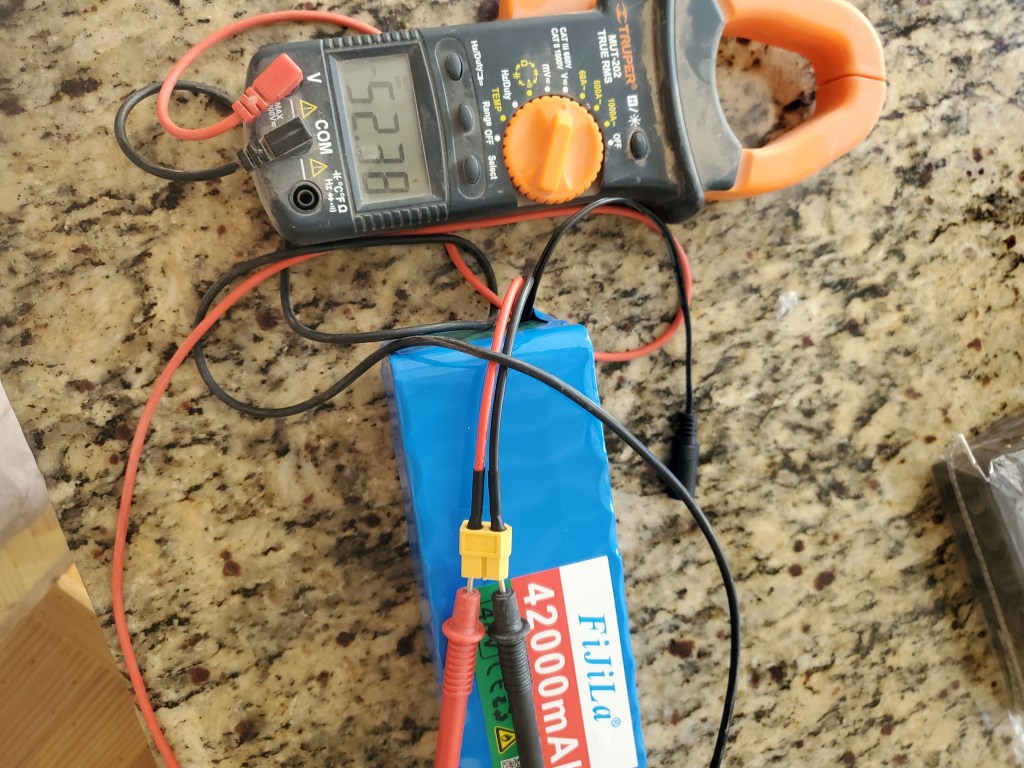
    Voltage tester showing 52.38 volts

    On the low end:

    • A low charge on a 48V battery might be anything below 48V
    • A very low or critical level might be 45V or lower

    Letting a battery stay at very low voltage for long periods can cause problems.

    When a Battery “Goes to Sleep”

    Lithium-ion batteries include a Battery Management System (BMS) that protects the cells. If voltage drops too low, the BMS may shut the battery down completely. This is often referred to as the battery “going to sleep.”

    This can happen if:

    • The battery is stored empty
    • The bike isn’t used for months
    • The battery self-discharges below the safe threshold

    In many cases, the battery isn’t dead—it just needs to be woken up.

    Waking Up a Sleeping Battery

    A battery can sometimes be revived by:

    1. Applying a gentle charge that raises the voltage above the BMS wake-up point
    2. Once the battery passes that threshold, the BMS allows normal charging again

    Warning: This should be done carefully. Using the correct charger and monitoring voltage is critical. If the battery does not respond or heats up, stop immediately.

    How to Recondition a Lithium-Ion E-Bike Battery

    Reconditioning doesn’t mean making a battery “like new,” but it can improve performance and restore usable capacity.

    Step-by-Step Reconditioning Process

    1. Inspect the Battery
      • Check for swelling, corrosion, cracks, or water damage
      • If you see physical damage, do not attempt reconditioning
    2. Measure Voltage
      • Use a multimeter or display (if available)
      • Confirm whether the battery is within a recoverable range
    3. Slow, Full Charge
      • Use the correct charger for the battery voltage
      • Allow the battery to charge fully (e.g., up to 54V for a 48V battery)
    4. Controlled Discharge
      • Ride the bike normally until the battery reaches a low—but not empty—level
      • Avoid pushing it to complete shutdown
    5. Repeat the Cycle
      • Performing 2–3 full charge/discharge cycles can help rebalance cells
      • This allows the BMS to recalibrate and can restore range
    6. Return to Partial Charging
      • After reconditioning, avoid constant 100% charging unless needed

    Removable vs Built-In Batteries

    Removable Batteries

    • Easier to recondition and test
    • Can be charged indoors at stable temperatures
    • Easier to store at optimal charge levels

    Built-In Batteries

    • Harder to access and measure
    • Reconditioning often requires the bike to be present
    • Storage and temperature control can be more challenging

    Both types use lithium-ion chemistry, but removable batteries generally last longer due to better care and storage options.

    How Many Charge Cycles Does an E-Bike Battery Last?

    Most lithium-ion e-bike batteries are rated for:

    • 500 to 1,000 full charge cycles

    A “cycle” means using roughly 100% of the battery’s capacity, not just plugging it in once.

    In real-world use:

    • Partial charges count as fractions of a cycle
    • Gentle riding and partial charging can significantly extend lifespan

    How Long Does an E-Bike Battery Last in Years?

    With average use:

    • 3 to 5 years is typical
    • Well-maintained batteries can last 6–8 years
    • Poorly maintained batteries may fail in 2–3 years

    Factors That Affect Battery Lifespan

    • Charging to 100% every day
    • Frequently running the battery to empty
    • High heat or freezing temperatures
    • Long-term storage at very low or very high charge

    Best Habits to Extend Battery Life

    • Store batteries at 40–70% charge when not in use
    • Avoid leaving the battery fully empty
    • Don’t store at 100% for weeks at a time
    • Charge in moderate temperatures
    • Use the correct charger for your battery voltage

    Final Thoughts

    E-bike batteries are consumable, but they don’t have to be disposable. Understanding voltage, charging behavior, and proper storage can dramatically extend their life. In many cases, a battery that seems “dead” simply needs to be reconditioned or woken up safely.

    With good habits and occasional maintenance, you can get more years, more cycles, and more rides out of your e-bike battery.